"One thing to remember is to talk to the animals.
If you do, they will talk back to you. But if you don't talk to
the animals, they won't talk back to you, then you won't
understand, and when you don't understand you will fear, and when
you fear you will destroy the animals, and if you destroy the
animals, you will destroy yourself."
Cree speaker (attributed to Chief Dan George)
Current
Research
Research in the Cameron lab aims to understand the origin and
evolution of animal body plan diversity. The oceans are home to
the bulk of global animal diversity, and nowhere are body plans
more divergent than among the invertebrate animals. This
biodiversity is largely a result of the interplay between
evolution, development and the fluid environment. For this reason,
our research program uses a multidisciplinary approach including
comparative morphology and development, phylogenetics, genomics,
fluid mechanics and paleontology. We are broadly interested in the
origins and evolution of animal biodiversity, and the
deuterostomes, that evolutionary linage that includes
hemichordates, echinoderms and our own phylum, the chordates, is
where we make our greatest contributions.
The Origins of Extracellular Matrix Structures (EMS) in
Deuterostomes
With
support from the National Science and Engineering Council of
Canada (NSERC) we are investigating three deuterostome EMS:
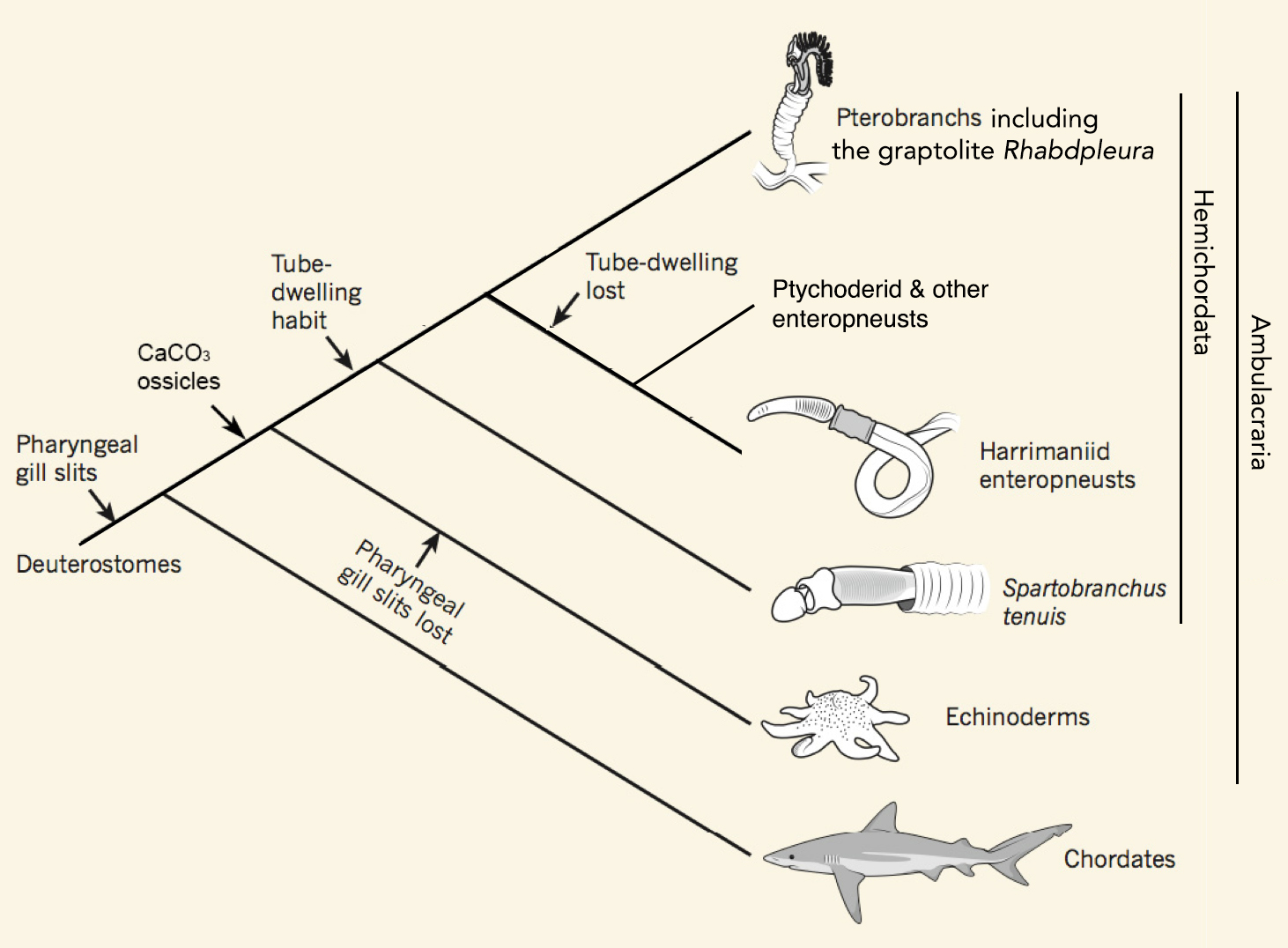
gill bars, ossicles, and tubes (Fig. 1). Deuterostomes include
three phyla; the Hemichordata are a small group of marine
invertebrates that are sister group to Echinodermata (that
together form the ‘Ambulacraria’), which in turn is sister to the
Chordata (Fig. 1). Hemichordates are comprised of two major
classes, the solitary acorn worms, and the colonial, tubicolous
pterobranchs (including graptolites, Mitchell et al. 2013 - see Publications).
Early in my career I hypothesized that the ancestor to the
deuterostomes was an acorn worm with a pharynx perforated with
gills used in filter feeding (Cameron et al., 2000).
Thanks to international collaborators and curious students we have
found support for this hypothesis using comparative and functional
morphology (Cameron 2002), molecular development and comparative
genomics including the finding of synteny of pharynx and gill
developmental genes (Simakov
et al. 2015), gill physiology (Sackville
et al. 2022
), the
discovery of Cambrian fossil acorn worms (Caron et al. 2013,
Nanglu et al. 2016). Moreover, extinct echinoderms (stylophorans)
had gills used in filter feeding that were lost in the line to
modern taxa (Álvarez-Armada
et al., 2022) (Fig. 1). Today, this hypothesis is widely accepted.
The
current goals of my NSERC program are to adopt the same
multidisciplinary approaches to test two novel hypotheses on the
origin and evolution of deuterostome EMS. First, my discovery of
echinoderm-like skeletal ossicles in acorn worms (Cameron,
C.B. & Bishop 2012;Larouche-Bilodeau &Cameron, 2022)
has led to the
hypothesis thatechinoderm ossicles are an
Ambulacraria plesiomorphy. Secondly, our discoveries of tube
dwelling Cambrian acorn worms, has led to hypothesis thatpterobranch
tubes are a hemichordate plesiomorphy.
Fluid Biomechanics & Animal Body Plan Evolution
With support from the Fonds de recherche du Quebéc
- Nature et Technologies
(FQRNT) we are characterizing the interaction of animal body plans
with the fluid environment using numerical, computational and
experimental methods. Unlike most selective forces, the physical
forces of fluid mechanics can be precisely quantified. In some
cases, changing this pressure results in drastically divergent
phenotypes. Two of the projects currently underway include i)
understanding the fluid-structure interactions of soft corals in a
dynamic flow environment, and ii) understanding the interaction of
oil droplets in seawater with the feeding appendages of
zooplankton, barnacles (Letendre et al. 2022, 2023), tunicates
(Beaudry & Cameron 2025), polychaetes (Beaudry & Cameron
2024), and corals. Results of these experiments and theory
(Letendre et al. 2020) is being used to mitigate the uptake of oil
in aquatic and marine food webs. The long term objective of these
investigations is to tightly couple the selective force of fluid
mechanics with developmental repatterning, to understand the role
of fluid forces on animal body plan evolution. This work is in
collaboration with the fluid dynamic research group at École
Polytechnique.
Discovering Hemichordate Biodiversity
The third major research axis of our group is to discover and
describe new species of Hemichordata. We are revising the taxonomy
of the phylum and we have more than tripled the number of
described species along the coasts of North America. Observations
on their biogeography suggest that the hemichordates are an
ancient and declining group, and that species loss in coastal
waters has accelerated due to human activities. Many species are
yet to be discovered from the largest habitat on earth, the deep
sea. For the most up-to-date information on Hemichordates species
see our
Hemichordata Images, Checklist
of Hemichordate Species, and Taxonomic
Key to the Enteropneusta.
Our research has been widely covered in the press and links to
some of the most recent articles are on the Publications
page. If you are interested in pursuing graduate studies or a
post-doc in the Cameron lab, or just looking for more detailed
information, please write.